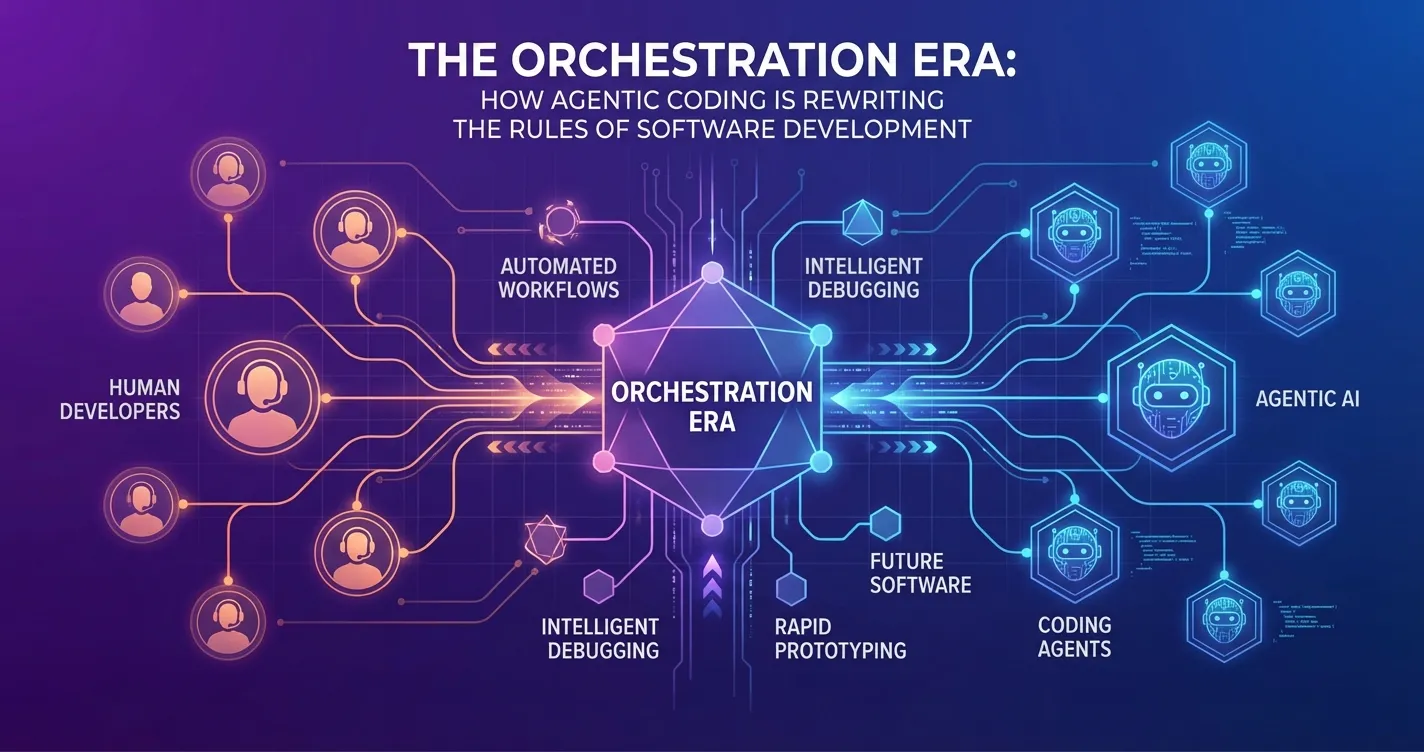
According to Anthropic's 2026 Agentic Coding Trends Report, developers already use AI in roughly 60% of their work, yet report being able to fully delegate only 0 to 20% of their tasks. That gap between pervasive adoption and limited trust is closing fast, and the distance between early adopters and late movers is widening with every quarter.
The Biggest Shift Since the GUI
Something fundamental is changing in how software gets built. Not incrementally, the way a new framework nudges practices forward every few years, but structurally. The locus of developer work is migrating from writing code line by line to orchestrating networks of autonomous agents that write, test, deploy, and maintain code on behalf of humans. The report frames this transition as a move from assistance to collaboration.
Across eight trends organized into three categories (Foundation, Capability, and Impact), the report argues that the gap between usage and delegation is closing fast and that the distance between early adopters and late movers is widening with every quarter.
Part I: The Foundation
Trend 1: The Software Development Lifecycle Changes Dramatically
The report opens with a bold structural claim: the entire software development lifecycle is changing dramatically. This is not about faster autocomplete or smarter linting. The abstraction layers that define how developers work are evolving. Where assembly gave way to high-level languages, and high-level languages gave way to frameworks, agentic coding introduces another layer, one in which the developer's primary output is not code, but specifications and oversight for agents that produce code.
Rather than being replaced, engineers are becoming more full-stack. A backend specialist who once handed off front-end work can now direct an agent to handle that surface, reviewing the output rather than writing it. Onboarding timelines collapse from weeks to hours, and dynamic "surge" staffing, spinning up agent capacity for short bursts of intense project work, becomes operationally viable.
Case Study: Augment Code
Part II: The Capabilities
Trend 2: Single Agents Evolve into Coordinated Teams
If 2025 was the year coding agents moved from experimental curiosity to production tool, 2026 is the year single agents evolve into coordinated teams. The report identifies multi-agent orchestration as a defining capability trend: systems in which multiple specialized agents collaborate on different facets of a task, governed by hierarchical coordination protocols.
This shift demands new skills from developers. Task decomposition, breaking a complex goal into subtasks an agent can own, becomes as important as writing clean functions. Agent specialization and coordination protocols emerge as first-class architectural concerns.
Case Study: Fountain
Trend 3: Long-Running Agents Build Complete Systems
Early coding agents excelled at bounded, short-horizon tasks: generate a function, write a test, refactor a module. The report documents a qualitative shift toward agents that handle the messy reality of software development, including ambiguity, iteration, and error recovery, over timescales measured in hours, days, or even weeks rather than minutes.
The consequences ripple outward. Projects that were formerly non-viable become economically feasible. Technical debt becomes a target for systematic elimination rather than perpetual deferral.
Case Study: Rakuten
Trend 4: Human Oversight Scales Through Intelligent Collaboration
The report surfaces a "collaboration paradox": engineers rely on AI extensively but trust it to operate autonomously on only a narrow slice of work. The typical pattern is using AI in cases where the developer already knows what the answer should look like.
This is not a failure of the technology. It is a reflection of how trust calibration works. Engineers delegate easily verifiable, low-stakes tasks while retaining conceptually difficult and design-dependent decisions. The bottleneck is not raw AI capability but the absence of robust verification tooling and trust frameworks.
The report predicts three developments that will close this gap:
- 1Agents that learn when to ask for help rather than guessing
- 2Agentic quality control that becomes a standard part of CI/CD pipelines
- 3A shift in human oversight from reviewing everything to reviewing what matters
Case Study: CRED
Trend 5: Agentic Coding Expands to New Surfaces and Users
Agentic coding is eroding the boundaries of who can build software. Language barriers disappear: legacy environments running COBOL, Fortran, or domain-specific languages become accessible to developers who never learned those languages. Non-engineering roles, including cybersecurity analysts, operations managers, designers, and data scientists, adopt coding tools as an amplifier of their expertise.
The result is that everyone becomes more full-stack, using AI to augment core expertise while expanding into adjacent domains.
Case Study: Legora
Part III: The Impact
Trend 6: Productivity Gains Reshape Software Development Economics
It would be easy to reduce the productivity story to "developers ship faster." The report resists that framing. It identifies three multipliers driving productivity gains: improving agent capabilities, better orchestration of those agents, and more effective use of human experience.
While time per task shows a net decrease, the much larger effect is a net increase in total output volume. About 27% of AI-assisted work consists of tasks that would not have been done otherwise. These are the "papercuts": minor bugs, small UX improvements, documentation gaps that teams perpetually deprioritize under time pressure but that collectively degrade product quality.
| Organization | Domain | Key Metric |
|---|---|---|
| Augment Code | Enterprise Software | 4-8 months compressed to 2 weeks |
| Fountain | Hiring / Logistics | 50% faster screening; 2x conversions |
| Rakuten | AI/ML Infrastructure | 7 hrs autonomous on 12.5M LOC; 99.9% accuracy |
| CRED | Fintech (15M+ users) | 2x execution speed |
| Legora | Legal Technology | Domain-specific agentic workflows |
| TELUS | Telecommunications | 30% faster shipping; 500K+ hours saved |
| Zapier | Automation / SaaS | 89% org-wide AI adoption; 800+ internal agents |
Case Study: TELUS
Trend 7: Non-Technical Use Cases Expand Across Organizations
Coding capabilities are spreading beyond engineering into legal, design, marketing, and operations. Organizations seeing the largest gains are the ones enabling this diffusion deliberately.
Case Study: Zapier
Anthropic's own legal team provides a telling internal case study. A lawyer with no coding experience built self-service tools using Claude Code, and the team reduced marketing review turnaround from two to three days to 24 hours.
When domain experts can self-serve on a growing share of their tooling needs, engineering teams can redirect their attention toward harder, higher-leverage problems. The result is not fewer engineers but engineers working on different and more impactful challenges.
Trend 8: Security Improves on Defense, But Also on Offense
The same agentic capabilities that empower developers and domain experts also empower threat actors. Security knowledge becomes democratized in both directions: defenders gain tools to scan, detect, and remediate vulnerabilities faster, but attackers gain tools to discover and exploit those same vulnerabilities at scale.
Security as Strategic Differentiator
Four Priorities for 2026
The report closes with four priority areas for organizations navigating the agentic transition:
- 1Multi-Agent Coordination. Invest in systems where multiple specialized agents work together. Develop task decomposition and coordination protocols as core engineering competencies.
- 2Scaling Human-Agent Oversight. Build tooling for efficient human review of agent outputs. Focus human attention on high-stakes, design-dependent decisions rather than routine verification.
- 3Extending Agentic Coding Beyond Engineering. Enable domain experts in legal, design, operations, and other functions to use coding agents directly, reducing dependency on engineering as an intermediary.
- 4Embedding Security Architecture from the Earliest Stages. Adopt security-first design for all agentic systems. Proactively address dual-use risks before they scale.
Key Takeaways
Several cross-cutting themes deserve emphasis:
- The orchestration paradigm is now dominant. The fundamental unit of developer work is shifting from lines of code to task specifications for agents. Organizations that measure developer productivity in commits or pull requests will miss the real signal.
- The delegation gap is the critical bottleneck. The 60% usage vs. 0-20% full-delegation disparity suggests the binding constraint is not AI capability but human trust infrastructure: verification tools, rollback mechanisms, and confidence frameworks.
- Timeline compression is an economic force. When project timelines drop by an order of magnitude, projects that were below the viability threshold become feasible. The 27% of AI-assisted work that represents entirely new tasks is evidence that the productivity effect is generative, not merely accelerative.
- The organizational footprint of coding is expanding. The audience for coding tools is no longer bounded by job title. Organizations that treat agentic coding as an engineering-only initiative will capture a fraction of the available value.
- Security is a strategic differentiator. The same tools empower attackers and defenders, which means security posture will increasingly separate resilient organizations from vulnerable ones.
The goal is not to remove humans from the loop but to make human expertise count where it matters most.
— 2026 Agentic Coding Trends Report, Anthropic
The eight trends described in this report are not predictions so much as observations of trajectories already underway. The question for organizations is not whether to engage with agentic coding but how quickly they can close the gap between using AI and truly orchestrating it. Those that move decisively, investing in multi-agent coordination, building trust frameworks, extending coding tools beyond engineering, and embedding security from the start, will define the next era of software development.
References
- 12026 Agentic Coding Trends Report(Anthropic)